

Master Technical SEO for Higher Rankings
The only technical SEO guide you’ll ever need in 2026. 100% beginner-friendly, updated for INP, render blocking rules, Google’s 2025-2026 algorithm changes + free checklist.

Disclosure: This article may contain affiliate links, which means we may earn a commission if you click on the link and make a purchase. We only recommend products or services that we personally use and believe will add value to our readers. Your support is appreciated!
Share this Post!

Introduction
In the ever-evolving digital æther, where organic visibility dictates commercial prosperity, the mastery of Search Engine Optimization (SEO) is no longer merely advantageous—it is utterly imperative. Yet, within the expansive discipline of SEO, one often-overlooked yet profoundly critical component serves as the veritable bedrock for all success: Technical SEO. This is the clandestine engineering that ensures your website is not only beautiful to human visitors but, more importantly, perfectly intelligible and easily navigable for the tireless search engine crawlers.
Understanding the Role of Technical SEO in Modern Search
Why Technical SEO is the Foundation of High Rankings
Technical SEO represents the subterranean scaffolding upon which all your content and link-building efforts must rest. Without a robust technical foundation, even the most exquisite, insightful content will struggle to gain traction in the serpentine algorithms of modern search engines like Google. It is the initial, non-negotiable hurdle. A technically sound website is one that loads with alacrity, is easily discovered, correctly interpreted, and is deemed trustworthy by the search apparatus. Poor technical execution results in impediments to indexing, diminished crawl efficiency, and a ultimately, a suppression of your site’s ranking potential.
Understanding Technical SEO
What Technical SEO Really Means
Technical SEO encompasses the manifold optimizations performed directly on the website and server to enhance the crawling and indexing phase for search engines. It’s about optimizing the mechanics of your site rather than the content itself. This sphere of action includes site speed, security, architecture, structured data implementation, and the management of crawl directives. Essentially, it’s the endeavor to align your site’s operational framework with the exacting technical prerequisites of search engines.
How Technical SEO Differs from On-Page and Off-Page SEO
The distinctions are fundamental. On-Page SEO focuses on optimizing the content and the visible elements within a specific webpage—think keyword usage, meta tags, and internal content quality. Off-Page SEO, conversely, deals with promotional and authority-building activities outside your website, primarily through backlinks and social signals. Technical SEO, however, exists a layer beneath both; it ensures the delivery system for that content is flawless. If on-page is the elegant prose and off-page is the prestigious publication, technical SEO is the pristine, high-speed press that prints and distributes the work.
The Connection Between Technical SEO and User Experience
A significant convergence exists between technical SEO and User Experience (UX). A technically optimized site is inherently a better user experience. Pages that load instantly, a secure connection, and a logical, intuitive navigation structure benefit both the indexing bot and the human visitor. Search engines have become surrogates for user satisfaction, rewarding websites that are fast, accessible, and stable. Technical diligence, therefore, directly translates into superior engagement metrics and, consequently, higher search visibility.
Website Architecture and Structure
Why Site Architecture Matters for SEO
The architecture of your website is its hierarchical taxonomy. A well-conceived architecture is paramount because it dictates the flow of link equity (PageRank) and aids in the contextual grouping of content. A flat, logical structure—typically one where important pages are only a few clicks from the homepage—facilitates easier discovery and indexing of all your valuable content. Conversely, a deep, convoluted structure can result in crucial pages becoming orphaned, hindering their visibility.
How to Build a Crawl-Friendly Site Structure
The cardinal rule is simplicity and logic. Utilize a silo structure where related content is grouped under broad category pages, creating distinct, thematically-focused segments. Adopt a breadth-not-depth approach; this means having more pages at a shallow depth rather than fewer pages buried many levels deep. Each page should have a clear, deliberate path back to the homepage.
Best Practices for Internal Linking and Navigation
Internal links are the arteries of your site structure, distributing authority and guiding both users and crawlers. Employ descriptive, anchor text that accurately reflects the target page’s content, eschewing generic phrases like “click here.” Your primary navigation should be simple, consistent, and utilize HTML/CSS rather than JavaScript for fundamental links to ensure maximum accessibility for crawlers. Implementing a simple, consistent breadcrumb trail on all non-homepage pages is also an excellent tactic for enhancing both UX and crawlability.
Crawling and Indexing
How Search Engines Crawl and Index Websites
Search engines deploy automated programs, or spiders (colloquially known as crawlers or bots), to follow links from page to page, downloading and analyzing the content they encounter. Crawling is the discovery process; indexing is the subsequent process of organizing and storing this content in a vast database. A page must be successfully crawled and indexed to even qualify for a search result.
Optimizing Robots.txt for Better Crawl Control
The robots.txt file is the gatekeeper—a text file that provides directives to compliant crawlers, instructing them on which parts of your site they are permitted to access or must avoid. It is critical for managing your crawl budget by preventing the bots from wasting time on low-value or duplicate content areas, such as /wp-admin or internal search results. Ensure it is syntactically correct and doesn’t inadvertently disallow access to content you wish to rank.
Using XML Sitemaps to Guide Search Bots
An XML Sitemap is not a guarantee of indexing but a strong, formal suggestion to search engines of all the URLs you deem important. It’s a comprehensive, organized list that helps crawlers discover pages they might otherwise miss, particularly on newer or very large sites. Include critical metadata like the last modification date and, where relevant, priority. Submit your sitemap directly to Google Search Console (GSC) for continuous monitoring.
Fixing Crawl Errors with Google Search Console
GSC is your essential diagnostic cockpit. The “Crawl Stats” and “Index Coverage” reports are invaluable. They illuminate instances where the crawler encountered 4xx (client-side) or 5xx (server-side) errors, or pages blocked by robots.txt or a noindex tag. Diligently addressing these errors is paramount, as persistent, uncorrected errors signal poor site health to the search engines.
URL Structure and Optimization
Creating SEO-Friendly URLs that Rank
A URL (Uniform Resource Locator) is a crucial identifier. An ideal URL should be semantically rich and easily decipherable by both users and search engines. It should incorporate the primary target keyword for the page and be succinct. Avoid non-essential, extraneous characters or session IDs.
Best Practices for URL Length, Keywords, and Hierarchy
Keep URLs as concise and descriptive as possible. A URL that clearly reflects the page’s hierarchy aids user understanding and provides a positive relevance signal. Utilize hyphens as the word separator—avoid underscores or spaces. Enforce lowercase letters consistently. For example, /technical-seo-guide/ is superior to /p=1234&category=seo.
Managing Dynamic URLs and Canonicalization
Dynamic URLs, often characterized by complex strings of parameters (?id=123&sort=price), are harder for crawlers to interpret and can lead to duplicate content issues. Where possible, rewrite these into cleaner, static-looking URLs. When rewriting is infeasible, use the canonical tag effectively to designate the single preferred version of the page, ensuring that all link equity is consolidated to that chosen URL.
Site Speed and Performance Optimization
Why Speed is Critical for Technical SEO Success
Site speed is no longer a tertiary metric; it is an explicit ranking factor. A slow website creates a jarring, frustrating user experience, leading to high pogo-sticking and abandonment rates. Google prioritizes websites that load with lightning speed, demonstrating a commitment to user satisfaction.
Tools to Measure and Improve Page Load Times
Essential tools for a comprehensive speed analysis include Google’s PageSpeed Insights (PSI), WebPageTest, and GTmetrix. These platforms offer granular diagnostics, revealing precise performance bottlenecks in your code, server, and media assets.
Reducing Server Response Time and HTTP Requests
A slow server response time, often called Time To First Byte (TTFB), can cripple performance. This requires optimizing your hosting infrastructure, employing efficient database queries, and potentially utilizing a Content Delivery Network (CDN) to geographically distribute your assets. Minimize the number of HTTP requests by consolidating CSS and JavaScript files, a technique known as minification and concatenation.
Optimizing Images and Scripts for Faster Loading
Images are frequently the primary culprit for sluggish load times. Compress images without sacrificing significant quality, use next-generation formats like WebP where supported, and implement lazy loading for images not immediately visible in the viewport. Defer or asynchronously load non-critical CSS and JavaScript to prevent them from blocking the initial rendering of the page content.
Mobile Optimization
Mobile-First Indexing and Its SEO Impact
The era of Mobile-First Indexing means Google predominantly uses the mobile version of your website’s content and structure for crawling, indexing, and ranking. If your mobile experience is deficient, your overall SEO performance will suffer, regardless of the desktop site’s quality.
Responsive Design vs. Mobile Versions
Responsive Web Design (RWD), where the site adapts its layout dynamically to the user’s screen size, is the canonical recommendation from Google. This is superior to maintaining separate, distinct mobile versions (e.g., m.example.com), which introduce complexity, potential canonicalization errors, and increased maintenance overhead.
Ensuring Seamless User Experience Across Devices
A seamless experience is characterized by fast loading, easy-to-tap elements, appropriate font sizing, and non-intrusive interstitials. Navigation should be easily accessible, and the key content must be immediately available without scrolling beyond the initial viewport on a mobile device.
Secure and Accessible Websites
The SEO Benefits of HTTPS and SSL Certificates
HTTPS (Hypertext Transfer Protocol Secure) is a non-negotiable ranking signal. It encrypts communication between the user’s browser and the server, ensuring data integrity and security. Implementing an SSL/TLS certificate is mandatory, and you must ensure all mixed content (HTTP assets on an HTTPS page) issues are meticulously resolved to avoid browser security warnings.
Improving Website Accessibility for All Users
Web accessibility (WCAG compliance) is increasingly aligning with technical SEO best practices. Features like proper ARIA attributes, keyboard navigation support, and correct use of heading tags and alt text not only aid users with disabilities but also provide clearer structural signals to search engine crawlers. A truly accessible website is a more thoroughly indexed website.
Fixing Common Security Issues That Affect Rankings
Malware infections, spam injections, and phishing compromises can lead to Google flagging your site with a “This site may be harmful” warning, resulting in an immediate and catastrophic drop in rankings. Regular security audits, strong server configurations, and diligent software updates are necessary to prevent these pernicious ranking detriments.
Core Web Vitals
Understanding Core Web Vitals and Their Metrics
Core Web Vitals (CWV) are a set of three specific, user-centric metrics that Google considers essential for a good overall user experience. They form a key component of the Page Experience ranking signal. The three metrics are: Largest Contentful Paint (LCP), First Input Delay (FID), and Cumulative Layout Shift (CLS).
How to Improve LCP, FID, and CLS Scores
- LCP (measures loading performance): Optimize your server, deliver resources quickly, and render the largest visible element swiftly.
- FID (measures interactivity): Minimize JavaScript execution time and break up long tasks to ensure the page responds rapidly to user input.
- CLS (measures visual stability): Reserve space for media elements, avoid injecting content above existing content, and use CSS transforms instead of properties that trigger layout changes.
Using PageSpeed Insights to Track Performance
PSI is the authoritative tool for tracking your CWV performance. It provides both Field Data (real-user experience data from the Chrome User Experience Report) and Lab Data (diagnostic data collected in a simulated environment). Consistent monitoring and a relentless pursuit of the “Good” thresholds are crucial for sustained ranking success.
Structured Data and Schema Markup
How Schema Helps Search Engines Understand Your Content
Structured Data is a standardized format for providing explicit, semantic meaning to your content. Schema Markup (using vocabulary from Schema.org) is the microdata that you wrap around your content, giving search engines unambiguous clues about the entity being described—be it a recipe, a product, an event, or an organization. This is a crucial step towards semantic SEO.
Implementing Rich Snippets for Higher CTR
Proper implementation of relevant Schema Markup enables your pages to qualify for Rich Snippets in the search results (e.g., star ratings, price, or image carousels). While not a direct ranking factor, these visually enhanced results dramatically improve your Click-Through Rate (CTR), driving more organic traffic.
Testing and Validating Structured Data
The Schema Markup Validator and the Rich Results Test are indispensable tools. They ensure your implementation is syntactically correct and qualifies for rich results. Errors here mean your efforts are in vain; validate every implementation before deployment.
Duplicate Content and Canonicalization
Identifying Duplicate Content Issues
Duplicate content refers to substantive blocks of content that appear on more than one URL, either internally or externally. This dilutes link equity, confuses crawlers, and can lead to the search engine arbitrarily selecting a single version to index. Common causes include URL parameters, print-friendly versions, and non-canonical use of both HTTP/HTTPS or www/non-www versions.
Using Canonical Tags Correctly to Consolidate Authority
The canonical tag (<link rel="canonical" href="...">) is the primary technical mechanism to signal the preferred, authoritative version of a piece of content to search engines. It effectively tells the bot to consolidate the ranking signals from all the duplicate versions onto the one designated master URL.
Managing URL Parameters and Pagination
In GSC, you can instruct Google on how to handle specific URL parameters (e.g., &color=blue) to prevent them from generating duplicate indexable pages. For paginated content (e.g., /category?page=2), the modern recommendation is to ensure each page has a self-referencing canonical tag and to rely on Google’s intelligence to crawl the sequence, though a consolidated view with a canonical to the first page remains a viable strategy in some contexts.
Crawl Budget Optimization
What Crawl Budget Is and Why It Matters
Crawl budget is the limited number of pages a search engine bot is willing to crawl on a given website within a specific time frame. This is a critical consideration for vast websites (e.g., e-commerce, large publications). If your site is inefficient, the bot may exhaust its budget before reaching your newest, most valuable content, leading to delayed or missed indexing.
How to Maximize Crawl Efficiency on Large Websites
Maximizing efficiency involves a multi-pronged stratagem:
- Block low-value URLs using
robots.txtornoindex. - Maintain a clean, logical site architecture to expedite discovery.
- Ensure your server response time (TTFB) is exceptionally fast.
- Remove all broken links and redirects, as they waste the bot’s time.
- Keep your XML Sitemap accurate and clean.
Using Server Logs to Identify Crawl Patterns
Server log file analysis provides the unvarnished truth about how, when, and how frequently search engine bots are interacting with your website. By examining these logs, you can identify pages that are being crawled too often (and should potentially be blocked) and pages that are being neglected, allowing for targeted optimization of internal linking and crawl directives.
Technical SEO for JavaScript Websites
How Search Engines Handle JavaScript Content
Search engines have advanced considerably, but JavaScript (JS) content presents a formidable challenge. Google’s process involves two main waves: an initial, fast crawling of the raw HTML, followed by a slower rendering phase where a headless browser executes the JS to see the final, rendered DOM (Document Object Model). Content reliant solely on JS for existence may face significant indexing latency if not correctly rendered.
Best Practices for Rendering and Indexing JS Pages
The paramount rule is to ensure all crucial content and links are present in the initial HTML payload before any JavaScript is executed. Utilize hydration techniques effectively and strictly adhere to best practices for modern web frameworks. Crucially, test your core pages using the URL Inspection Tool in GSC to ensure the Googlebot-rendered version matches the user-facing version.
Using Dynamic Rendering or Pre-Rendering for SEO
For sites struggling with the inherent complexities of JS, dynamic rendering (serving crawlers a pre-rendered, static HTML version while serving users the full JS version) or pre-rendering (generating static HTML for all pages) can be effective palliatives. These methods mitigate indexing issues by ensuring the crawler receives a fully formed, consumable page.
Site Migrations and Redirections
How to Plan and Execute a Successful Site Migration
A site migration (changing domains, platforms, or structure) is an operation of perilous complexity. A meticulous, multi-stage plan is mandatory. Map every old URL to its corresponding new URL (the redirect map). Conduct extensive pre-launch audits of the staging environment and establish a robust, post-launch monitoring protocol.
Implementing 301 Redirects Without Losing Rankings
The 301 permanent redirect is the standard for preserving link equity during a migration. They must be implemented server-side (e.g., via .htaccess or server configuration files), and they must be direct—avoiding long chains of redirects, which dilute link equity and waste crawl budget.
Testing and Monitoring Post-Migration Performance
Immediately after launch, monitor GSC for any spikes in 404 errors or drops in indexing. Use a comprehensive third-party tool to crawl the entire site and verify that all 301 redirects resolve correctly. Closely track traffic and rankings for at least 6-8 weeks, addressing any observed anomalies with alacrity.
International and Multilingual SEO
Using Hreflang Tags for Global Websites
For websites targeting different languages or geographical regions, the hreflang attribute is essential. It signals to search engines the relationship between different language versions of the same content, preventing them from being mistakenly identified as duplicate content. Tags must be bidirectional (if page A links to page B, page B must link back to page A).
Managing Country and Language Targeting in Search Console
In GSC, you can utilize the International Targeting settings to specify a target country for country-specific domains (ccTLDs like .co.uk). For generic domains (gTLDs like .com), hreflang is the primary mechanism for signaling intent, often combined with geographic signals from hosting and internal linking.
Avoiding Duplicate Issues in Multiregional Sites
Implement hreflang meticulously, but also consider using canonical tags within each language cluster. For instance, if you have both /en-us/ and /en-gb/ versions, they should typically canonicalize to themselves, while the hreflang tags indicate their cross-language relationship.
Image and Video Optimization
Optimizing Image Alt Text, Titles, and Formats
Images contribute significantly to load time but are also potent SEO assets. Alt text is vital for accessibility and provides the content’s semantic meaning to search engines; it should be descriptive and incorporate relevant keywords. Use appropriate file formats (JPEG for photos, PNG for graphics) and compress ruthlessly.
How Video SEO Enhances Search Visibility
Video content can secure coveted spots in video carousels and rich results. Video SEO involves optimizing the video itself (descriptive title, transcript, tags) and the host page (clear surrounding content). Video is a compelling engagement amplifier.
Implementing Video Schema and Sitemaps
Utilize Video Schema Markup to provide specific, detailed information about the video (duration, thumbnail URL, upload date). Additionally, submit a dedicated Video Sitemap through GSC to ensure prompt and complete discovery of all video assets, which can be critical for visibility in specialized video search tabs.
Technical SEO Tools and Audits
Essential Tools for Technical SEO Analysis
A successful technical SEO strategy relies on an arsenal of analytical tools. Indispensable resources include: Google Search Console (GSC), Google Analytics (GA), Screaming Frog SEO Spider (for comprehensive internal site crawls), Ahrefs/SEMrush (for competitive analysis and backlink audits), and the Google Rich Results Test.
How to Conduct a Comprehensive SEO Audit
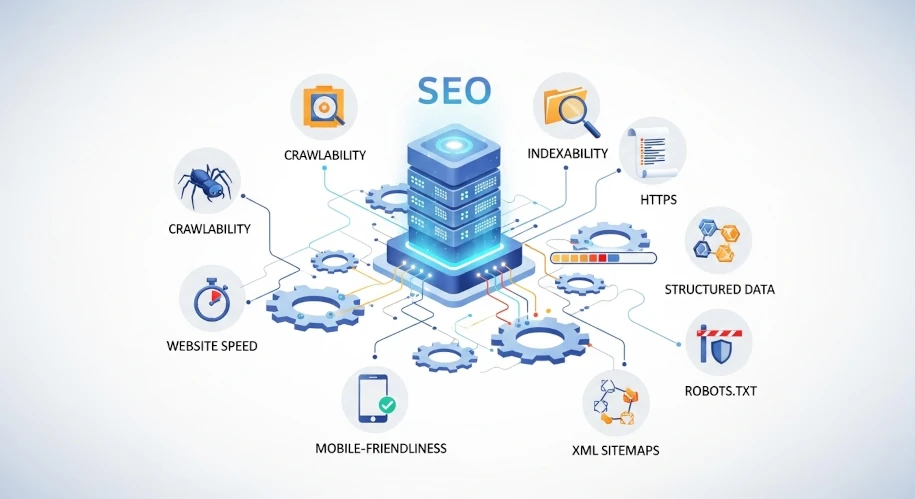
An audit is a surgical investigation into every facet of the site’s technical health. It should be a cyclical process, not a one-time event. The audit must methodically examine: site architecture, crawlability, indexability, page speed (CWV), mobile-friendliness, security (HTTPS), and structured data implementation.
Interpreting Audit Data to Prioritize Fixes
The data gleaned from an audit will often be a deluge of issues. Prioritization is key. Focus first on issues that constitute hard blocks to indexing (e.g., severe crawl errors, noindex errors on critical pages, or server-side issues). Next, tackle major performance-impacting issues like poor CWV scores, and then move to optimizing for efficiency and semantic clarity (Schema, hreflang).
Monitoring and Maintenance
Regular Technical SEO Health Checks
Technical SEO is not a static project; it is an ongoing state of vigilance. Conduct regular (e.g., monthly) health checks on core metrics: Index Coverage, Crawl Stats, and CWV scores. Automation is key to catching issues before they become catastrophic.
Automating Monitoring for Errors and Downtime
Utilize third-party uptime monitoring services to alert you instantly to server downtime. Set up custom alerts within GSC for significant drops in organic traffic or sudden spikes in crawl errors. Continuous Integration/Continuous Deployment (CI/CD) pipelines should include automated checks to prevent the deployment of code that introduces common technical SEO errors.
Adapting to Algorithm Updates and New SEO Standards
The search landscape is perpetually dynamic. Major algorithm updates (e.g., Core Updates) necessitate a rapid diagnostic review. Stay abreast of emerging standards (e.g., new Schema types, changes to JS rendering policies) to ensure your site remains optimally configured for the next paradigm shift.
Common Technical SEO Mistakes
Frequent Errors That Harm Site Performance
The litany of common errors is long but instructive. They include: Blocking critical CSS/JS via robots.txt, inconsistent canonicalization across URL versions, orphan pages lacking internal links, redirect chains of three or more hops, and slow TTFB due to poor hosting or database performance. These are the technical stumbling blocks that impede organic ascendancy.
How to Detect and Fix These Mistakes Quickly
Use a full site crawl tool (like Screaming Frog) to instantly flag redirect chains, broken links, and non-canonical pages. GSC’s URL Inspection tool will reveal how Google renders and indexes a specific page. By automating regular, full-site crawls and cross-referencing the data with GSC, you can catch and rectify these blunders before they calcify into long-term ranking suppression.
Future of Technical SEO
Emerging Trends Shaping the Future of SEO
The future of technical SEO will be characterized by an even deeper focus on speed, user experience, and semantic understanding. Expect the importance of client-side rendering (JS frameworks) to be increasingly scrutinized and new performance metrics to emerge. Entity-based SEO will become paramount, making meticulous Schema markup a baseline requirement.
How AI and Automation Will Transform Technical SEO
Artificial Intelligence (AI) and Machine Learning (ML) are set to revolutionize technical auditing and maintenance. AI-powered tools will be able to perform predictive analysis on code deployment, automatically flagging potential SEO regressions. Automation will allow for the instantaneous generation of complex items like hreflang tags and structured data, moving the technical SEO expert toward a role of strategic oversight and complex problem-solving rather than rote manual implementation.
Conclusion
Key Takeaways for Mastering Technical SEO
Mastering technical SEO is not an esoteric pursuit; it is the sine qua non of modern search marketing. The key takeaways are clear: Speed is sacrosanct; a seamless, secure User Experience is the filter through which all rankings flow; and precision in architectural and data markup is mandatory for efficient crawling and semantic interpretation.
Turning Technical SEO Insights into Sustainable Growth
By maintaining a rigorous, proactive focus on the technical health of your website—regularly auditing your architecture, optimizing for Core Web Vitals, and implementing meticulous structured data—you transition from merely reacting to algorithm changes to actively engineering a platform that is structurally predisposed to rank highly. Technical SEO is the engine that converts content and links into sustainable, compounding organic growth.
About Author

Master Your Rankings. Fuel Your Growth.
Get the exact SEO blueprints used by top digital innovators. From technical fixes to content strategy, we provide the tools you need to take control of your search visibility.
Your information will be used in accordance with our Privacy Policy
You may also like reading
-

The 2026 Technical SEO for Beginners blueprint I used to rank 100+ sites. Includes…
-
The only technical SEO guide you’ll ever need in 2026. 100% beginner-friendly, updated for…
-

Unlock your online potential! This guide demystifies SEO, offering a simple roadmap to boost…